This is an essay I wrote as an assignment for a class in the Philosophy of Mathematics I was taking in the Spring semester of 2017 as an undergraduate at MIT. Although I admit that more exact language is needed in some places, the essay is printed here in its originally drafted version and the volume that follows will revisit concepts considered in this essay more carefully. While it is true that the advances of modern mathematics, specifically Calculus and Measure theory do provide very useful mechanisms for thinking about instants of time and measures of position as integrations of velocity as a density, Zeno’s paradox raises important questions that have yet to be answered about the structure of knowledge and formation of fact in the universe.
Abstract: Zeno says that (quoting from Aristotle’s Physics) “since a thing is at rest when it has not shifted in any degree out of a place equal to its own dimensions, and since at any given instant during the whole of its supposed motion the supposed moving thing is at the place it occupies at that instant, the arrow is not moving at any time during its flight.” Aristotle thinks that what’s wrong with Zeno’s argument is the assumption that an interval of time is made up of instants, whereas, in fact, “time is not made up of atomic ‘nows’.” What do you think.
Naturally, physics is the study of the physical world. When studying the physical world, the notion of position is a very natural one. If an object’s position changes as time passes, we say that object is moving. Over time as this idea was being explored, a reasonable extension is a way to quantify an objects movement, otherwise known as speed (or velocity in multiple dimensions). If we have two moving objects which have the same position at one time, and different positions at a future time, then it is clear that the speed of one is greater than that of the other. Clearly , so B must have a greater speed than A, since A and B were traveling for the same amount of time,
We say that an object’s speed is given by
; ;
Note that if , then and . We can now say with confidence
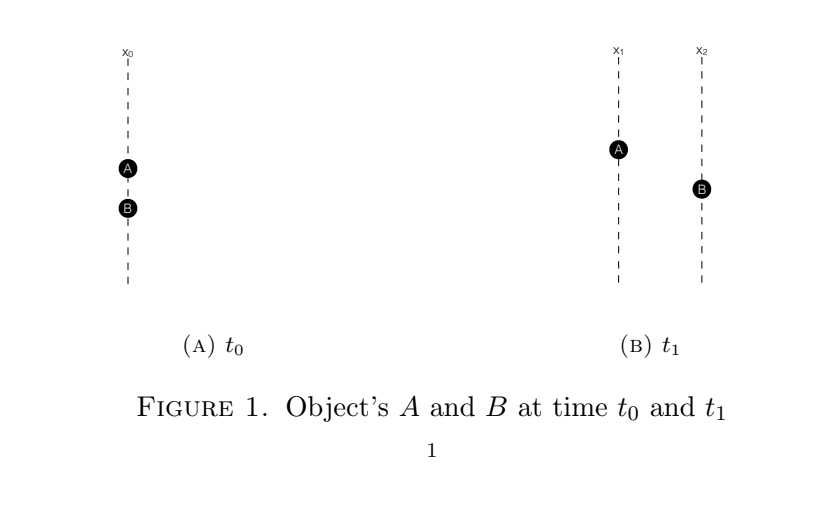
In other words we have a way of comparing the speed of two objects. If we know the speed of one object is greater than the speed of another object, we know that the first object will travel a greater distance in the same length of time. Conversely, if we know one object traveled a greater distance than another object in the same length of time, we know that the first object had a greater speed than the second.
But Zeno’s question centers around calculating speed at an instant, or what is known as instantaneous speed. Instantaneous speed is defined as the derivative of position with respect to time at an instant. The derivative is defined as
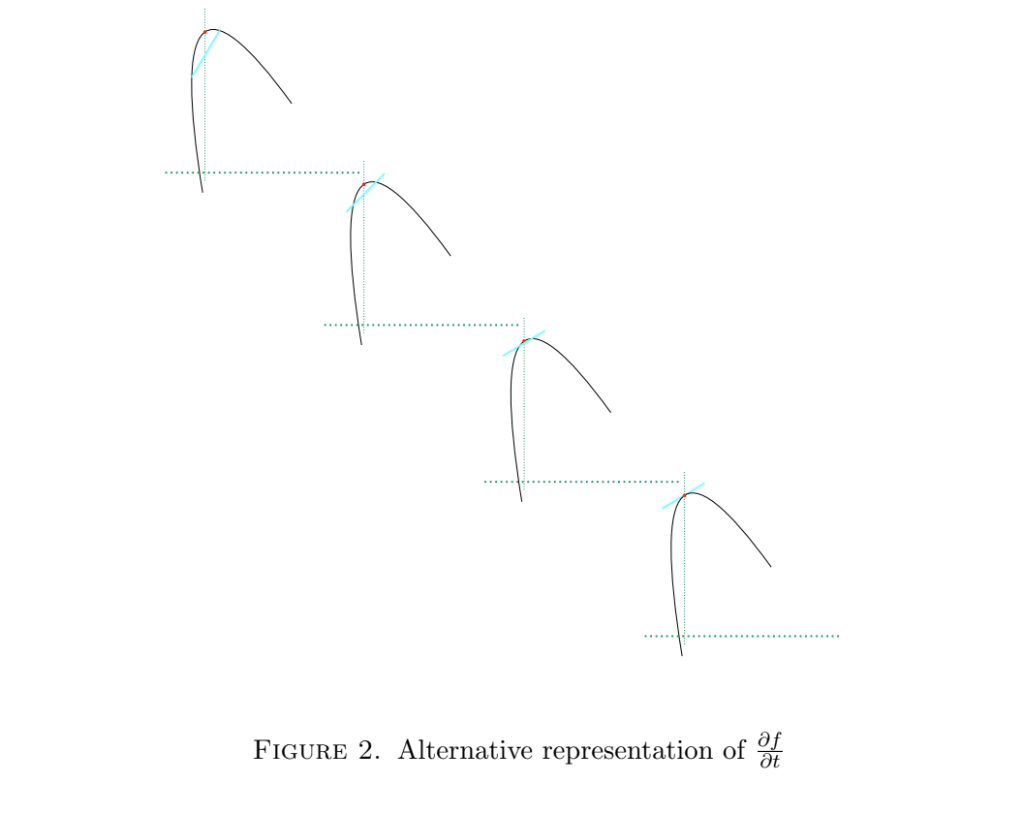
The derivative of a function at a point can be visualized as the slope of the limit of the sequence of secant lines centered around that point, as the points used to calculate the secant line get arbitrarily close together. Thus the instantaneous speed of an object at time is
By Aristotle’s definition of motionlessness, we see that any object that does not move during an interval of time must have a speed of zero , but Zeno’s paradox centers around instants of time. In these scenarios, , so our speed becomes an indeterminate form and the simpler conception of speed that does not involve the derivative does not seem to be suited to Zeno’s scenario.
Aristotle seeks to remedy this so called paradox by claiming that “time is not made up of atomic nows”, which seems to be a fruitful claim given the results of modern measure theory. It is very well known that uncountably infinite sums of the measure of disjoint sets are very poorly behaved. This will be demonstrated below.
Let us have a measure function μ:{subsets of R}→R+ that satisfies two constraints.
(i) if are a countably infinite sequence of disjoint sets then
(ii) and are congruent.
Let an equivalence class be a set of numbers
Enumerate all rationals let
.
Claim: All Nk are disjoint.
Proof: Let such that . Let . Suppose
, a contradiction.
Claim: .
Proof: For all , then for some . Additionally, clearly the combination of with the rationals is a subset of .
By our two claims:
Clearly μ(N)≥0. If , then , but if , then .
It seems as though must have measure as it is a countably infinite collection of sets which are themselves a countably infinite collection of points on the real number line, but if this set does have measure then we can very easily construct a set with infinite measure.
This is exactly the type of scenario which Zeno has brought up, he is thinking of the measure of subsets of the real number line, i.e. the length of a duration of time, as being equal to the measure of all of the points that make up the real number line. He is trying to consider the measure of subsets of the real number line as being equal to the sum of the measure of the individual points. We have just shown this notion to be a problematic one if we wish for our measure function to satisfy fairly tame constraints.
Previously we have defined speed as , but as we have shown that we cannot reliably measure , there is very little reason to believe that we can reliably measure over the same interval. So while Zeno is correct to say that an object is not moving at every instant in time, he is incorrect in believing that this is an accurate representation of that objects speed during that instant in time. Zeno focuses on the fact that in this “instant of time” the measure of the subset of the real number line given by is 0, but this isn’t the whole story as the measure of is also 0. Thus our general conception of is not at all suited for Zeno’s scenario.
The derivative, or notion of instantaneous velocity may help to shed some light on this problem. A function which has a derivative at every point is said to be continuous. Formally, a continuous function is defined as a function which for all , if
.
Clearly if a function is continuous, then its derivative exists at . But Zeno did not consider this concept, he did not consider instantaneous velocity to be the limit of this sequence as , he only considered the case where .
Aristotle’s statement “time is not made up of atomic nows” may or may not be correct. After thousands of years of mathematical advances there still is not a consistent answer. I personally think that time is in fact made up of atomic nows, as by the axiom of choice, there are instants in time. However, this does not mean that there is anything meaningful to be said about mathematical conceptions (read speed) that depend on the passage of time, “during” these instants. It is very clear that at an instant an object does not move, but it is also very clear that at an instant time itself does not move, and yet, time flows. So while I may disagree with Aristotle’s statement, I agree with the general sentiment.
We perceive motion and speed because time flows, and to try to extend our perception to those intervals of time of length 0 is to remove that which is quite possibly most central to the way in which we perceive our surroundings. Although the axiom of choice may allow for us to select these instants of time which have undefined measure, it does not describe the physical meaning of such a choice. In order to select, and perceive these instants of time one must essentially stop time.
We as humans perceive the continual flow of time. Stopping time amounts to stopping this unknown mechanism which keeps time flowing, and if a human were to perceive such a scenario, the speed of the object may very well be 0, but the scenario was created by stopping the flow of time, an act which surely would require some expenditure of energy. Just because it is possible to imagine an instant of time does not mean that those instants of time are perceivable while they are happening.
In order to truly perceive the scenario Zeno has described, time would need to be stopped, and that stoppage of time may (in my opinion it would most definitely) require some expenditure of energy. However since that expenditure of energy does not happen while we perceive the passage of time, the object does not stop, and we do not observe those instants of time for which the object is motionless.
In this way Zeno’s paradox does not seem to describe the physical reality we experience, but rather the outcome of a physical reality which may be possible to experience, but only after some expenditure of energy which changes the course of all objects in the universe whose perception depends on the passage of time. By looking at instants of time Zeno stops time, and by stopping time, the universe Zeno’s paradox exists in is another universe which was created by changing the energy of our own universe, thus the scenario in Zeno’s paradox is likely not the same universe which we perceive and facts about this alternate universe cannot be assumed to be consistent with facts about our own.
 Agreeable Instantia
Leave a comment